PandavikSonicPicnic
Chapter two · colour

Choreography in the Curva

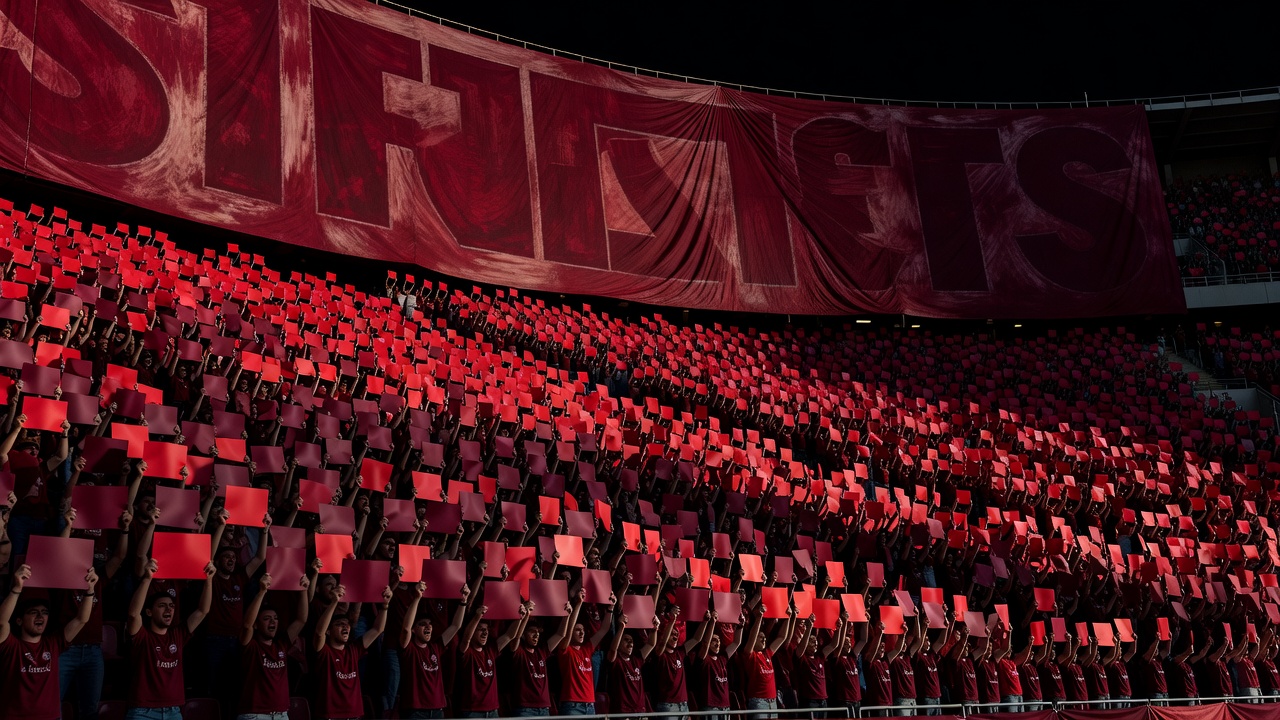
A curved stand covered by a giant painted tifo banner and coloured cards held by supporters, in a burgundy duotone
The moment before kick-off when a whole end becomes a single picture.

The Italian word tifo once meant a fever, and that is still the best description. Supporters in Italy have been called tifosi, the feverish ones, for generations. In the late 1960s, groups of young fans began gathering in the curved ends behind the goals, the curve, with names, banners and a sense of purpose that went beyond simply watching. The Fossa dei Leoni at AC Milan, founded in 1968, is often named as the first of these ultras groups. Within a decade almost every Italian club had at least one.

What an ultras group actually does

At heart, an ultras group is an organisation devoted to support. Members pay dues, attend meetings, travel to away matches together and take responsibility for the atmosphere of their stand. They own the big banners, the drums and the megaphones. They choose the songs. And, several times a season, they plan a choreography that requires months of preparation and the cooperation of thousands of people who are not members at all.

The culture spread quickly. Croatia, Serbia, Greece, Turkey, Germany, Poland, France and Spain all developed their own versions. In Belgrade, the Delije of Red Star turned the Marakana into one of Europe's most intense stadiums. In Istanbul, derbies between Galatasaray, Fenerbahçe and Beşiktaş are famous for their noise. South America followed its own parallel path through the barras, with Boca Juniors' La Doce, the twelfth player, the most famous of all.

How a tifo is built

  • The designA sketch, often a club crest, a historic figure or a message aimed at a rival, is scaled onto a seating plan, block by block.
  • The workshopVolunteers paint giant sheets of fabric in warehouses and car parks, sometimes for weeks. A banner can cover an entire stand.
  • The cardsFor mosaics, every seat receives a coloured card the night before. Each card is a pixel, and the picture only works if almost everyone lifts theirs at once.
  • The signalAs the teams appear, the capo calls it. Ropes pull the banner up, the cards rise, and for a minute the stand is a canvas.
The great walls

Stands with a personality

Some stands become characters in their own right. Borussia Dortmund's Südtribüne, the Yellow Wall, holds around 25,000 standing supporters, making it one of the largest single terraces in European football. Celtic's Green Brigade have produced choreographies that stretch around the North Curve. The Bombonera in Buenos Aires is built so steeply that supporters say it trembles when La Doce jumps.

These stands share one thing: they are run by people who think of the stand as home. They tidy it, defend its reputation and teach newcomers its songs.

Flat illustration of a towering single-tier stand packed with supporters and waving flags
Steady on safety

Flares, rules and respect

No honest account of ultras culture can skip the difficult parts. Pyrotechnics are spectacular in photographs but burn at temperatures that cause serious injuries, and they are illegal inside grounds in the United Kingdom and banned or restricted in many other countries. A minority of groups have also been linked to violence, intimidation and discrimination, which most supporters reject outright.

The best tifo needs none of that. Paper, paint, fabric and coordination are enough to stop people in their tracks. Many groups now work directly with clubs and safety officers to get designs approved, which means bigger displays, fewer bans and more people willing to join in. If you want to help, ask your club's supporter liaison officer or singing section how to volunteer.

Next chapter: the rituals that start long before kick-off.

  • VolunteerPainting days always need hands.
  • Hold your cardOne missing card leaves a hole in the picture.
  • Follow the capoTiming is everything.
  • Leave no traceClear your cards and tape after the match.