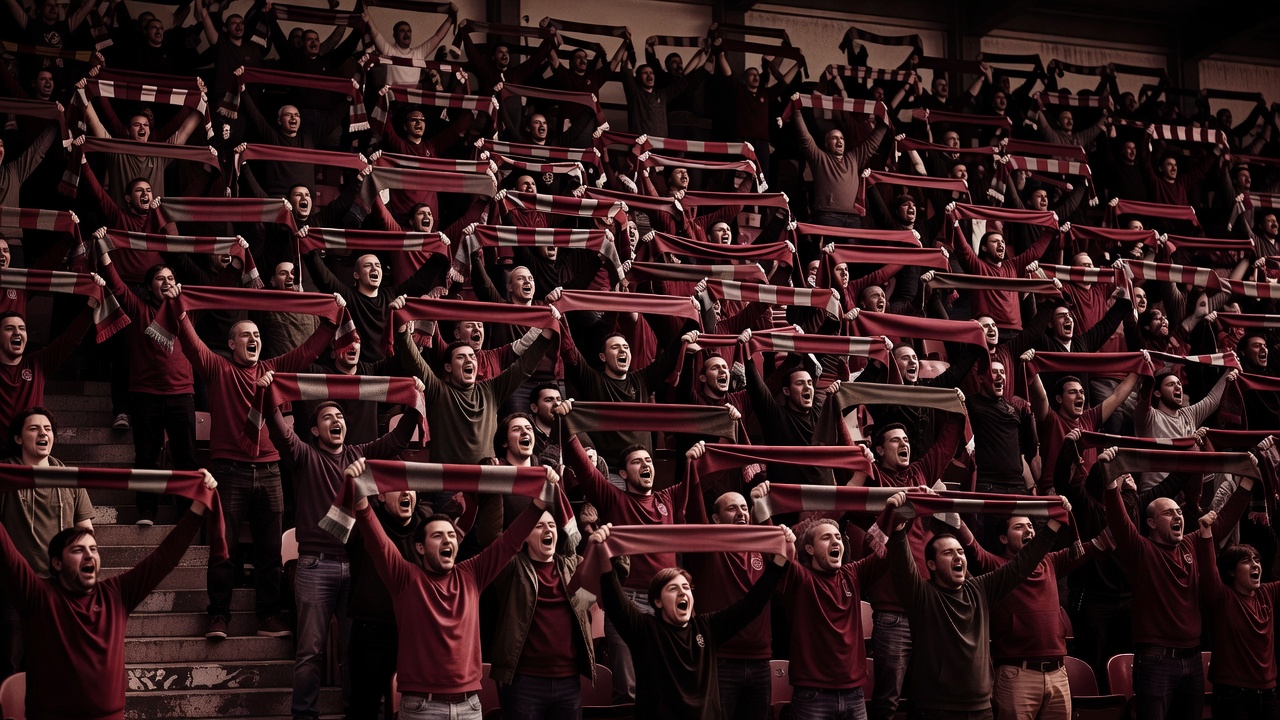
Stand in any football ground long enough and you will hear a song that nobody wrote for football. That is the first secret of the terrace chant: almost everything is borrowed. Hymns, music-hall numbers, pop hits, opera, nursery rhymes and advertising jingles have all been dragged into the stands, given new words and turned into something the original composer would barely recognise. The supporters are not just singing. They are editing, arranging and publishing, all at once and all from memory.
Where the oldest songs came from
British terraces in the early twentieth century already had their anthems. West Ham United supporters adopted “I'm Forever Blowing Bubbles”, a 1919 American music-hall song, in the 1920s, and it still floats across east London before kick-off. Hymns were common too, because many supporters knew them from church and school: “Abide with Me” has been sung before the FA Cup Final since 1927, a moment that still silences a national stadium.
The great change came in the 1960s, when pop music and the terrace met. On the Kop at Anfield, supporters began singing the Merseybeat records played over the tannoy. When Gerry and the Pacemakers took “You'll Never Walk Alone”, from Rodgers and Hammerstein's 1945 musical Carousel, to number one in 1963, the Kop kept singing it long after it left the charts. The song later became an anthem at Celtic, Borussia Dortmund, Feyenoord and many others, each claiming it with their own history.
How a chant spreads
A chant survives because it is easy. The best ones have a short phrase, a clear rhythm and room for a club or player's name. Someone near the front tries a line, a few neighbours pick it up, and if it works the whole stand joins within a minute. If it fails, it vanishes, and nobody mentions it again. This is folk tradition in its purest form: tested live, every week, in front of thousands of critics.
- Club Brugge · 2003Brugge fans in Milan began chanting the riff of The White Stripes' “Seven Nation Army”. Italy's supporters carried it to the 2006 World Cup, and from there it went everywhere.
- Ajax · 2008Cardiff City fans sang Bob Marley's “Three Little Birds” at a pre-season friendly in Amsterdam. Ajax supporters kept it, and it became one of their signature songs.
- Iceland · Euro 2016The slow “Huh!” thunderclap, reportedly picked up from Motherwell fans in 2014, became the image of a small nation's first major tournament.
- Lech Poznań · the PoznańTurning your back to the pitch, linking arms and bouncing. Manchester City fans adopted it after meeting Lech in 2010.